
Why 2026 Marks the Credible Shift
The transition of tokenized climate derivatives from experimental pilots to institutional reality hinges on a convergence of regulatory enforcement and infrastructure maturity. While previous years focused on the technical feasibility of issuing assets on-chain, 2026 marks a decisive pivot toward operational utility and legal certainty. This shift is not merely a market trend but a structural evolution driven by the full enforcement of the Markets in Crypto-Assets (MiCA) regulation across the European Union.
MiCA provides the first comprehensive legal framework for crypto-assets in a major jurisdiction, eliminating the regulatory ambiguity that previously deterred institutional capital. For climate derivatives, this clarity is paramount. Institutions require predictable compliance standards to price risk and manage counterparty exposure. The enforcement of MiCA’s provisions regarding asset-referenced tokens and e-money tokens creates a compliant on-ramp for traditional finance to interact with tokenized environmental assets.
Infrastructure maturity further supports this transition. The underlying blockchain networks and custody solutions have evolved to handle the volume and security requirements of institutional-grade derivatives. Smart contract audits, oracle reliability, and interoperability between traditional finance (TradFi) settlement systems and distributed ledger technology (DLT) have reached a threshold where operational risk is manageable. This technical readiness allows climate derivatives to function as liquid, tradable instruments rather than static records.
The focus has shifted from "can we issue on-chain" to "what should be on-chain to improve real-world outcomes." This pragmatic approach prioritizes the integration of verified carbon credits and renewable energy certificates into liquid derivative markets. By 2026, the primary value proposition of tokenized climate derivatives is their ability to provide transparent, auditable, and liquid exposure to climate-related risks and opportunities, backed by a robust regulatory and technical foundation.
The credibility of this shift is underscored by the alignment of regulatory bodies, technology providers, and institutional investors. As MiCA enforcement tightens and infrastructure improves, tokenized climate derivatives are positioned to become a standard component of sustainable finance portfolios, offering both liquidity and compliance in a single, integrated framework.
How Tokenization Solves Carbon Liquidity
Traditional carbon credit markets operate as opaque over-the-counter (OTC) ledgers. Buyers and sellers negotiate privately, often facing weeks of due diligence and manual verification before a trade settles. This friction creates a liquidity trap: high-quality assets remain stranded because the cost of finding a counterparty exceeds the asset's marginal value. Tokenized climate derivatives 2026 resolve this by converting illiquid, fragmented credits into standardized, programmable digital assets.
The primary mechanical advantage is fractionalization. By splitting a single carbon credit into thousands of on-chain tokens, tokenization lowers the entry barrier for institutional and retail participants alike. This granularity transforms carbon assets from bulk commodities into liquid financial instruments, allowing for precise hedging and micro-investing strategies that were previously impossible in the traditional registry system.
Settlement speed shifts from T+15 or longer to near-instantaneous finality. In traditional markets, the separation between trade execution and legal ownership transfer creates counterparty risk. On-chain settlement merges these steps: the transfer of title and the transfer of funds occur simultaneously via smart contracts. This atomic settlement eliminates the need for intermediaries such as clearinghouses or custodians, reducing both time and cost.
Transparency is enforced by the immutable nature of the blockchain ledger. Every minting, transfer, and retirement event is recorded publicly, creating an auditable trail that counters the "double-counting" scandals prevalent in voluntary carbon markets. This visibility is critical for regulatory compliance and corporate ESG reporting, where proof of origin and integrity is paramount.
Market Comparison: Traditional vs. Tokenized
The following comparison highlights the structural differences between legacy carbon trading and tokenized derivatives.
| Feature | Traditional OTC | Tokenized Derivatives |
|---|---|---|
| Settlement Time | 15–30 days | Seconds to minutes |
| Minimum Trade Size | 1,000–10,000 credits | 1 token (fractional) |
| Counterparty Risk | High (manual verification) | Low (atomic smart contracts) |
| Transparency | Private, opaque ledgers | Public, immutable chain |
| Liquidity | Fragmented, low volume | Deep, aggregated pools |
Market Context
Regulatory Frameworks Shaping the Market
The transition of tokenized climate derivatives from experimental protocols to institutional assets hinges on regulatory clarity. In 2026, the primary driver of this legitimization is not technological innovation alone, but the maturation of legal frameworks that define custody, reporting, and market integrity. Without these guardrails, institutional capital remains hesitant to deploy significant liquidity into climate-focused digital assets.
Europe leads this charge with the full enforcement of the Markets in Crypto-Assets (MiCA) regulation. MiCA provides a unified legal passport for crypto-asset service providers across the European Union, reducing the fragmentation that previously hindered cross-border trading. For tokenized climate derivatives, this means issuers can operate under a single, rigorous set of rules regarding transparency, reserve requirements, and consumer protection. This regulatory certainty has been a catalyst for the "credible year" status of 2026, allowing traditional financial institutions to integrate tokenized green bonds and carbon credits into their existing compliance infrastructure without navigating a patchwork of national laws.
In the United States, the landscape remains more complex but is steadily clarifying. While a comprehensive federal crypto law is still pending, regulatory guidance from the SEC and CFTC has begun to distinguish between security tokens and utility tokens, providing a pathway for climate derivatives to be classified and traded appropriately. The focus is increasingly on anti-money laundering (AML) compliance and the provenance of the underlying climate assets. Institutions are prioritizing platforms that offer robust Know Your Customer (KYC) integration and immutable audit trails, ensuring that the carbon offsets or renewable energy credits backing the tokens are real, verifiable, and not double-counted.
The convergence of these regulatory approaches is creating a more stable environment for tokenized climate derivatives 2026. As major economies align their standards, the risk of regulatory arbitrage diminishes, and the focus shifts to market efficiency and liquidity. This institutional-grade compliance is essential for attracting the large-scale capital needed to fund global climate initiatives, turning digital tokens into a serious tool for sustainable finance.
Market Infrastructure and Key Players
The infrastructure supporting tokenized climate derivatives 2026 relies on a convergence of traditional exchange technology and decentralized finance protocols. Major platforms are adapting their order matching engines to handle the unique compliance and settlement requirements of climate assets. Kraken, for instance, has outlined plans to integrate regulated derivatives with open tokenization, signaling a shift toward hybrid models that satisfy institutional risk mandates while retaining blockchain efficiency.
Standardization remains the primary bottleneck for liquidity. The Integrity Council for the Voluntary Carbon Market (ICVCM) serves as the central authority for quality assurance. As of March 2026, the ICVCM had approved nine carbon-crediting programs as Core Carbon Principles (CCP)-Eligible, alongside 38 specific methodologies. This approval process creates a whitelisted universe of assets that exchanges can safely tokenize, reducing counterparty risk for market participants.
The technical architecture for these instruments often mirrors traditional futures contracts but settles on-chain. This approach requires robust oracle networks to verify underlying climate data and smart contracts to automate margin calls and liquidations. The resulting market structure aims to provide the depth and transparency previously unavailable in over-the-counter climate finance.

Risks and Due Diligence Requirements
Tokenized climate derivatives 2026 operate at the intersection of traditional finance and emerging blockchain infrastructure. This convergence introduces specific risks that require rigorous due diligence. Investors must navigate smart contract vulnerabilities, regulatory fragmentation, and the persistent threat of greenwashing. Success depends on verifying both the digital asset's integrity and the underlying carbon credit's validity.
Review the smart contract's audit history from reputable firms. Unaudited or poorly documented code poses significant liquidity and security risks. Ensure the contract logic matches the legal terms of the underlying derivative.
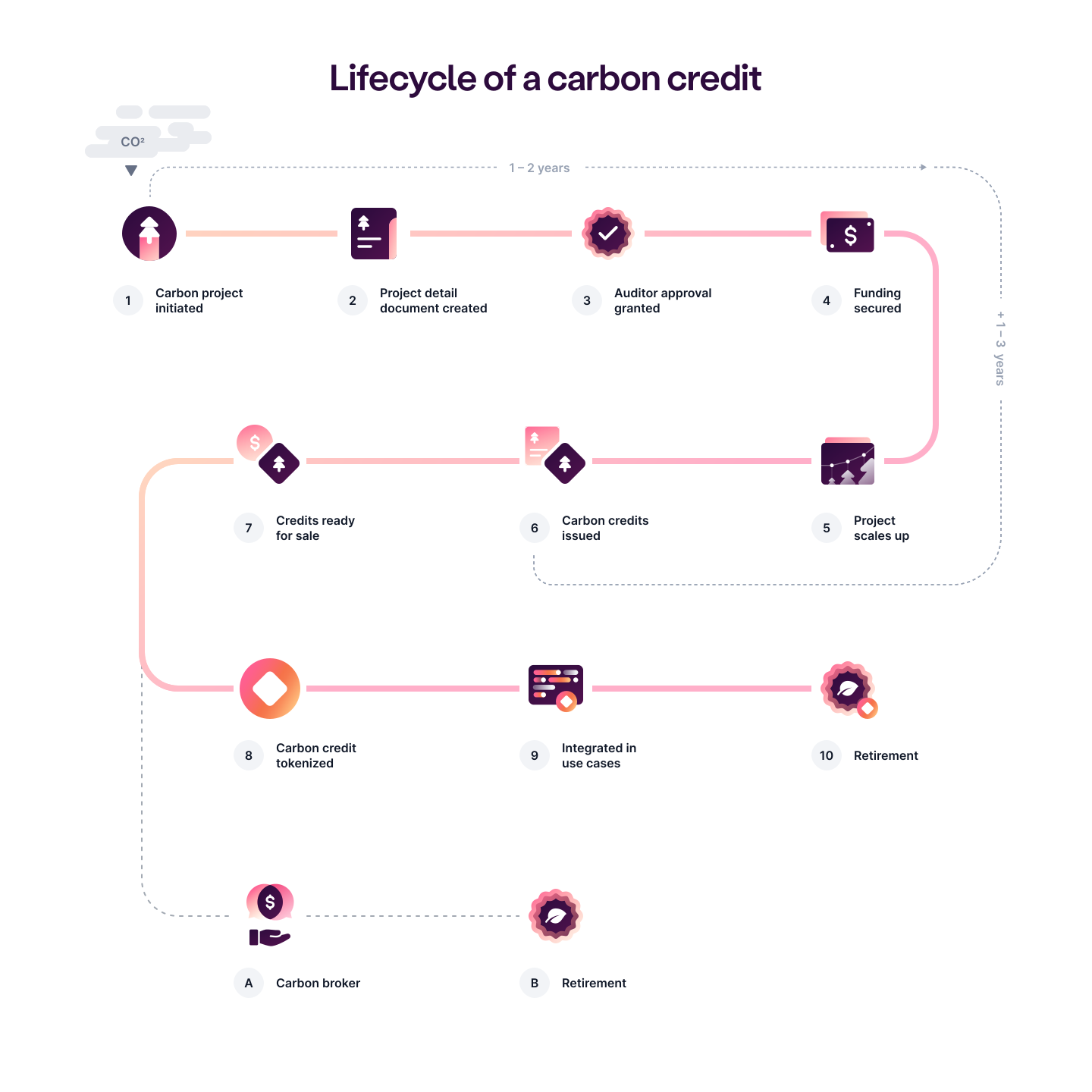
Check the origin of the underlying carbon credits. Verify the vintage year and the registry (e.g., Verra, Gold Standard) to prevent double-counting. Older vintages may face regulatory scrutiny or market devaluation in 2026.
Determine the regulatory framework governing the token. With MiCA enforcement in the EU and evolving SEC guidelines in the US, compliance status dictates legal recourse and liquidity options. Ensure the platform adheres to these standards.
Analyze the platform's order book depth and custodial arrangements. Illiquid markets can lead to significant slippage. Verify that assets are held by regulated custodians to mitigate counterparty risk.
Ensure the platform provides transparent, real-time data on the underlying asset's status. Regular third-party verification reports are essential to maintain credibility and prevent greenwashing claims.
| Risk Category | Mitigation Strategy |
|---|---|
| Smart Contract Vulnerability | Multi-signature wallets and independent audits |
| Greenwashing | Direct registry integration and vintage verification |
| Regulatory Shifts | Jurisdictional compliance checks and legal counsel |
The landscape for tokenized climate derivatives 2026 demands a disciplined approach. By systematically addressing these risks, investors can participate in this emerging market with greater confidence and reduced exposure to structural failures.
No comments yet. Be the first to share your thoughts!